
“Create your financial plan assuming a CAGR of 12% over the long-term” – you might have heard this line at many places – financial planning decisions, investing in a mutual fund, TV interviews, ads, online forums like Reddit and so on.
But if you ever felt confused by what CAGR really means, this article is for you. The concept of CAGR is very fundamental in order to understand bigger concepts like IRR, XIRR, TWRR, HPR and so on. All these measures are used to measure investment performance but with different point of views. But I won’t complicate things for you here. So let’s start to build your comprehensive understanding of CAGR.
What does CAGR mean & How is it calculated?
The full form of CAGR is Compound Annual Growth Rate. It tells you at what constant, single rate your invested money grew over your holding period.
The formula for calculating CAGR is as follows:
As you can see, all you need to calculate a CAGR is how much you invested, how many years you have stayed invested for, and how much the value has grown to today. And oh, a calculator.
For example, suppose you invested Rs 10,000 on 1st January 2020 in a mutual fund (or a stock, the formula applies to stocks as well). You held it for 5 years and the value is now Rs 20,000. The calculations for CAGR of this investment would look as follows:
current value stands for, well, the current value of your investment,
The answer comes to CAGR = 14.86%.
Pros and Cons of CAGR
The answer above of 14.86% means that your investment grew at that single rate of 14.86% for the full 5 year period. Once you have a calculator, it’s pretty simple isn’t it? And that is the most important benefit of using CAGR – it’s very simple to calculate and understand.
But hold on – that 14.86% is not true for every year now, is it? During those 5 years, your Rs 10,000 could have become Rs 15,000 in one year, then fall back to Rs 12,000 in the next one year and so on to end up at Rs 20,000 in year 5. And this is the biggest limitation of CAGR – it does not tell you how volatile your returns were during those 5 years. It just assumes that the rate of growth was a constant 14.86% every year.
Another limitation is that CAGR does not account for any investments or partial redemption you did, or dividends you received during those 5 years. For example, if you invest an additional Rs 5000 in the second year & take out Rs 6000 in the 3rd year, the CAGR formula does not consider those cashflows.
And finally, CAGR fails to display the emotional roller-coaster investors experience when they stay invested for long periods.
Take a look at the chart below which shows 3 different investments all of which have a CAGR of ~12% (11.86% to be precise). The light-blue dotted line represents Rs 100, which is the just there as a benchmark line for your easy understanding & comparing the volatility of 3 investments shown.
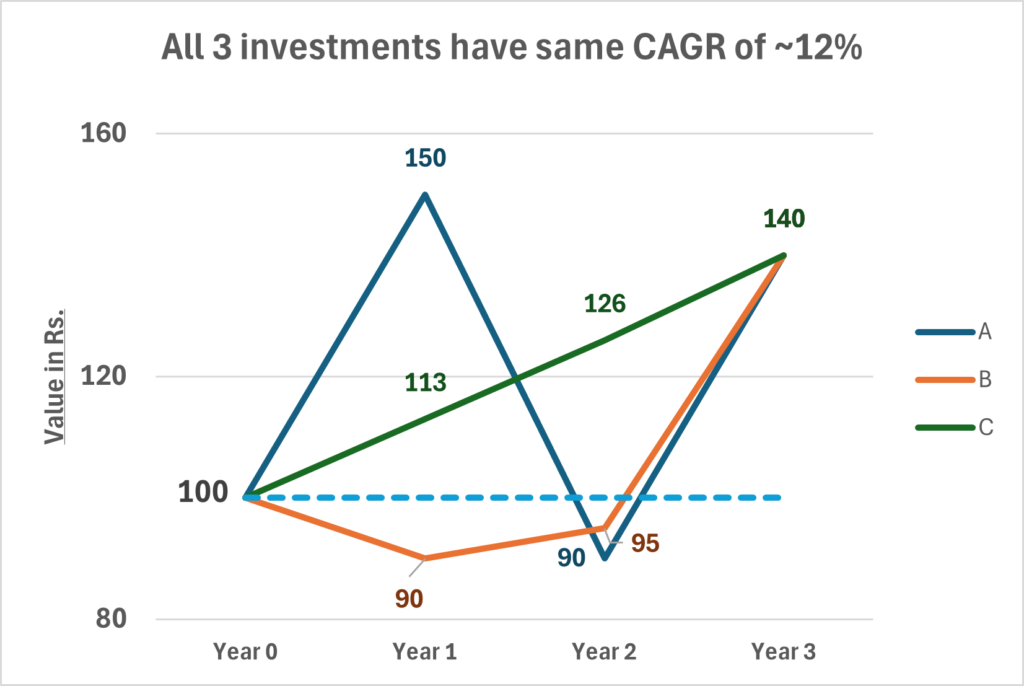
As you can see in the graph, despite all the 3 investments A, B, and C reaching a final value of Rs 140 after 3 years (starting from Rs 100), the journey they took is completely different. Investment A would have made you extremely happy after 1 year when it reached the value of Rs 150 and highly stressed when it fell to Rs 90. Your total returns in Year 1 would be +50% {(150/100)*100%-1)}, and for year 2, your returns would be -40% {(90/150)*100%-1)}. The CAGR after year 2 would be calculated as follows:
This behavior of investment A is called as sequence of returns risk – which simply means that the road to achieving average returns is full of high-flying emotions. In simple terms, the sequnce in which returns comes matter more for behavioral stability than the averages.
On the other hand, Investment B (the orange line) would have tested your patience for 2 years by staying below Rs 100, only to reward you for your patience in the 3rd year.
Investment C however, would have let you sleep peacefully during the entire period, by smoothly and constantly growing every year.
And despite these 3 completely different emotional and return paths of A, B and C, the end result is still the same: CAGR = 11.86%.
Think about it for a moment – CAGR doesn’t tell you the most important thing – what you actually experience on your journey to make average returns. Many investors might have sold investment A in year 1 when it rose or in year 2 when they got scared because it fell. Many others would have sold Investment B in the first 2 years when it went nowhere from Rs 100. Investment C? Something like that is what we would all love to own, won’t we? But in reality, most such smooth investments either come with lower returns, or hidden-risks.
Conclusion
To summarize, calculating CAGR gives you a single compound rate at which your investment grew over the your given holding period. While it is simple to communicate and understand, it does not account for any transactions or cash-flows in between, nor does CAGR communicate the volatility. Remember the 12% CAGR expectation over the long term that everyone tells you? What that number does not tell you is how the journey to that 12% will be – it could look like investment A which evokes strong emotions of happiness and stress, or it could look like Investment B where your patience as an investors really gets tested which almost makes you quit right before things are about to improve.
If you are using CAGR, keep in mind to use it where you invest only once and then hold it for a given period of time – like a lumpsum investment in a mutual fund – or for comparing returns of two mutual funds or stocks over a given time period (ignoring dividends).
But in reality, most of us invest via SIPs and withdraw money in between for many reasons like:
- You needed that money for something
- You got scared because your investment fell in value
- You ran out of patience because the investment is not growing fast enough as per your expectations
In such cases where there are transactions or investments/redemptions/dividends in between, XIRR (Extended Internal Rate of Return) is the right measure. You can read about it in my next article.
Meanwhile if you have any doubts about CAGR, put them in the comment and I will answer them. And if you like this article, please share it with someone who it can help.
Thanks for reading,
Prathamesh