

If you were ever asked by someone very new to investing “what is a share?”, you know how it goes – most analogies you can think of like splitting a pizza in 10 equal pieces among your friends, or dividing a shop into n equal pieces – all fall short, or end up confusing people.
“So as the first thing, I decided that I will attempt to simplify this one thing for you – what is a share and where does a share come from. If you find it useful, please use it prolifically in your next conversations – like if your grandpa or your 12 year old niece asks about it. Here is the simplest version I came up with:
Suppose you want to buy a land that costs Rs 1 crore. You know the price will double in the next one year. But you only have Rs 50 lakh. So what do you do? You approach one of your friends and ask him to put his Rs 50 lakh to buy the property with you, and he agrees. So, now you and your friend both own half of the land, and will share the profits 50-50 when you sell (or any loss as well!).
Now suppose instead of buying & selling this one property, you have an idea to start a business with your friend of buying and selling multiple properties to make more profits . But for that you need Rs 1 Cr more to buy more properties. Neither of you have that extra money.
Hence, you approach a rich uncle of your friend who is willing to partner with you and give you Rs 1 crore, but on one condition – you have to create a company.
What’s a company, you ask? Think about a company like a 4th person which is legally created. It is separate from the 3 of you, YET you three own it and have complete control over what it does.
At this stage – the stage of creating a company for a business – is where the government enters the picture. The government needs three important pieces of information before they let you all create a company:
- Who are going to be the owners?
- How much money they are putting in the company?
- How many shares you’d like to create?
Now this is the step where shares are created. The government dictates that the ownership of a company should be divided into small units called shares. The shares of a company exist on paper, you can’t see them. But they represent your real ownership in the company which is legal, and is accepted by everyone as a proof of your ownership. Thus, owning a share of a company means being an owner in the company and its profits.
Coming back to our example. So, you provide the government the information They need:
- There are 3 owners
- We are putting a total of Rs 2 Cr. One owner – Rs 1 Cr (50% ), remaining two owners – Rs 50 lakh each (25%-25%).
- Please create 10,000 shares
Once the 10,000 shares are created, they are divided among the three of you, in the same proportion as your contribution in Rs 2 Cr: 50%, 25% and 25%.
So the guy putting Rs 1 Cr gets 5000 shares (50%) and you two get 2500 shares each (25%-25%).
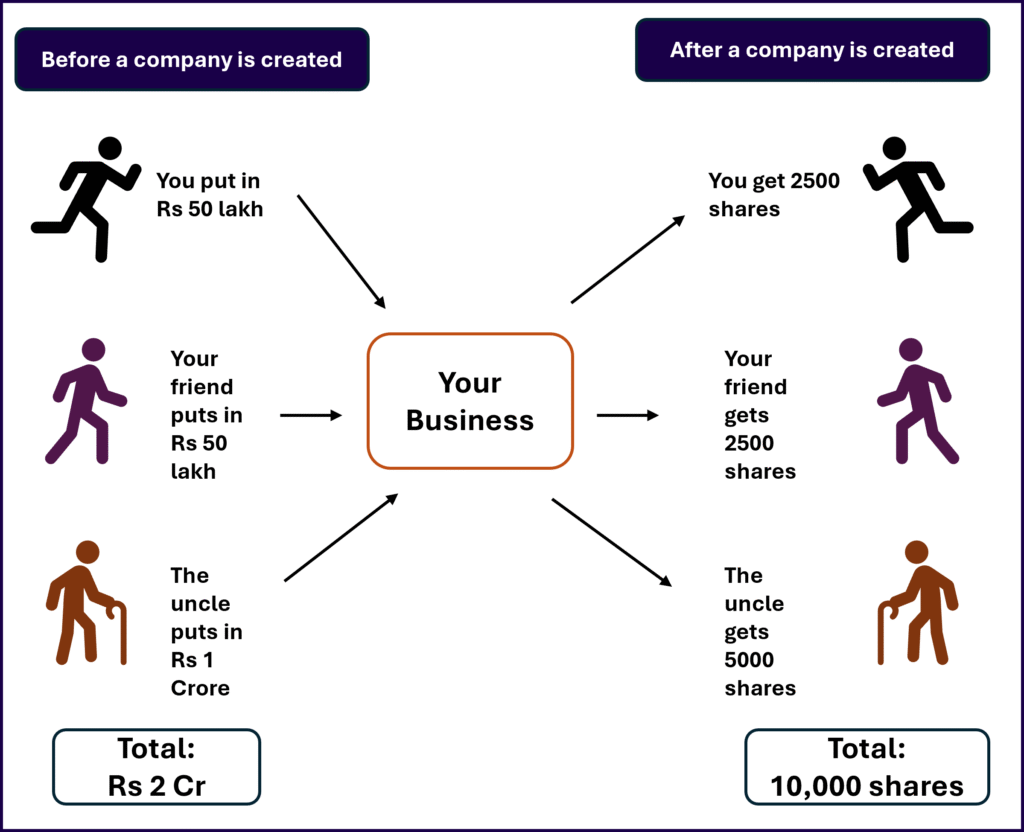
Creating shares makes it easy to divide and track the ownership of the company. So, by owning 2,500 shares, you now own 25% of the company. All the profits that the company will earn in the future will be divided 50%-25%-25% among the three of you.
Got it?”
I hope this example will help you explain shares in simplest possible words to anyone. Got an even better way to explain? Let me know in the comments. If it’s really better, I will publish it with credit given to you.
Now your niece or grandpa, after understanding shares, might ask you another question: “But why even buy shares? What benefits do they provide?”
Read my next article for this!

About Prathamesh
I am an IIM Bangalore alumnus. I was wealth manager for some of the riches HNI-UHNI families in India. Then I decided to venture out on my own to bring that expertise for everyday Indians. I am working to make highest-grade investment advisory accessible to every Indian. IMO the lesser the welath someone has, the more they can benefit from professional guidance. I like to write and talk about everything finace - investing, insurance, debt management, behavioral finance and so on. When I am not writing, I am making educational videos. And when I am not doing that either, I am catching up with the lates comedy or thriller shows and movies.