

As a beginner, I believe this will be the only article you will need to understand what an NFO is in mutual funds, and why there are so many of them these days. So let’s begin to understand what NFOs are and why they exist.
What is an NFO in mutual funds?
When an Asset Management Company (AMC) or Mutual Fund (MF) launches a new scheme, they collect the money from investors via a process called NFO or New Fund Offer. Each and every mutual fund scheme that exists out there came into existence by the process of NFO. Usually, the NFO period is 7-15 days long. During this phase, the AMC only collects the money for the scheme and keeps it safe to invest later. After that period, the NFO is said to be “closed”. Once the NFO is closed, the fund managers of this new scheme slowly start buying stocks or bonds (depending on the type of the scheme) from the collected money.
If an investor puts money in a scheme during an NFO, they get 1 unit of the scheme for Rs 10. For example, if you invest Rs 1000 during NFO period, you get 100 units. If you invest Rs 1 crore, you get 10 lakh units and so on.
After the NFO is over and the fund manager has invested the money in stocks or bonds (I will refer to them as ‘securities’ going forward), the NAV of Rs 10 changes based on how the value of those securities changes. If the fund manager invests mainly in equity shares and those shares go up, then the NAV will go above Rs 10. If the shares fall in price, then the NAV will also fall below Rs 10.
This is important to understand because “cheap” is not necessarily better. Just because the NAV is Rs 10 does not mean you should buy it over another scheme with NAV of Rs 100. The Rs 10 NAV during NFO is just an arbitrary starting point. If the scheme does well, the NAV will go up over time. Many popular schemes today have NAVs that are hundreds of rupees – meaning that they have grown the money of investors. There is no reason to invest in an NFO based on low NAV alone.
Shortly after the NFO period is over, the scheme starts accepting money from new investors as well as existing investors (if they wish to invest more). Every investor who comes after the NFO gets new units of the scheme at a price different from Rs 10, depending on whether the securities which the fund manager has bought have risen or fallen in value.
Why AMCs do NFOs?
The simple reason is to make money – for themselves and the investors. AMCs make money by charging investors a fee for managing their investments in the scheme. The term for that is Assets Under Management. The expense ratio of the scheme informs investors how much they are charging per year.
The second reason is that there are new AMCs in the market, and they don’t have enough schemes to serve investors with different risk profiles, needs and goals. For example, a new AMC might have a large cap fund which invests in Top 100 companies of the country, but no mid-cap fund for investors who want to invest in those stocks. So they launch an NFO for their mid-cap schemes to collect money from those other investors. Why they want to manage money of those investors as well? Read reason number one.
And finally, sometimes NFOs are launched because a theme (like infrastructure, defence, small-cap etc.) is currently popular. Launching an NFO around such themes makes it easier for the AMC to attract investors & their money. For example, many NFOs have come in the recent past which focused on infrastructure, defence , banking, logistics, manufacturing, small caps, digital India and so on. The logic is again the same – more AUM means more income for the AMC.
Whether or not to invest in NFO?
Now this is a question each investor has to answer to himself or herself. While future is generally unpredictable, there are many questions you can use to make your decisions such as:
- Do I trust the AMC or the person telling me to invest in the NFO?
- Does adding this new scheme provide me additional benefits that are missing from my current portfolio?
- Do I fully understand the risk of investing in it?
- Do I agree with the AMC about why they think this new NFO and the scheme is a good opportunity?
- Is there any other fund with a track record which does the same thing as this new scheme does?
The final decision should be taken based on the answers to the above questions as well as your risk appetite and asset allocation. Those are completely different topics which I will not get into here.
Finally, a word of caution about NFOs: If anybody tells you that you should invest in the NFO because you will never again get the units of the scheme at Rs 10 – run away from them as far as possible. They are clearly not being honest with you.
There is a simple reason – the NAV of the scheme depends on how the securities bought by the fund manager perform after he buys it. If they go up, NAV goes up. If they go down, NAV goes down as well. Let me give you a few examples here:
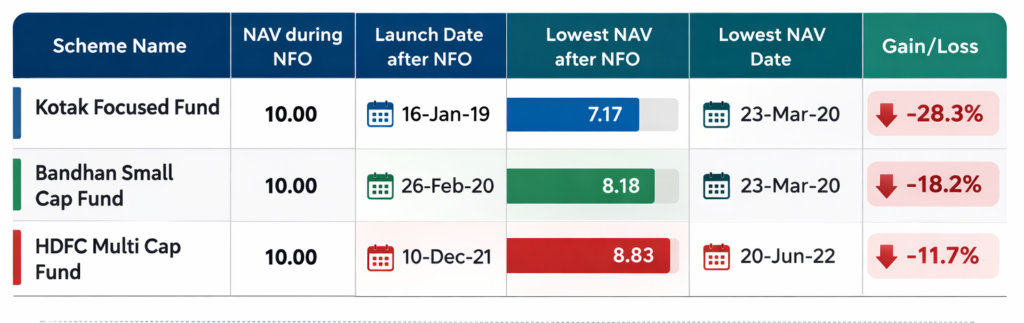
See? These three different funds from Kotak MF, Bandhan MF, HDFC MF – all had NFO price of Rs 10, and all of them went to Rs 7-8 when markets fell. So, the Rs 10 is not the minimum NAV of a scheme. It can always fall below that value if the markets don’t perform well or fund manager does a poor job of selecting stocks.
That’s the reason I said that the statement “You will never get the units at the lowest price again” is a lie. Depending on the market, you might be able to buy units at much lower price than the NFO price of Rs 10.
Conclusion
So to conclude, here are the 3 main points:
- NFO is how a scheme is created for the first time.
- NFOs are how AMCs gather investor money initially and start making money.
- NAV of units you get during the NFO period is Rs 10 per unit. It does not mean it is cheap and is arbitrary. It may rise or fall in the future depending on the market conditions.
- You should only invest in NFO if you understand what the scheme will do, whether you truly need what strategy it offers, and know the risks involved.
If you have any question, do type them in the comments, and I will answer them.
Thank you for reading,
Prathamesh